

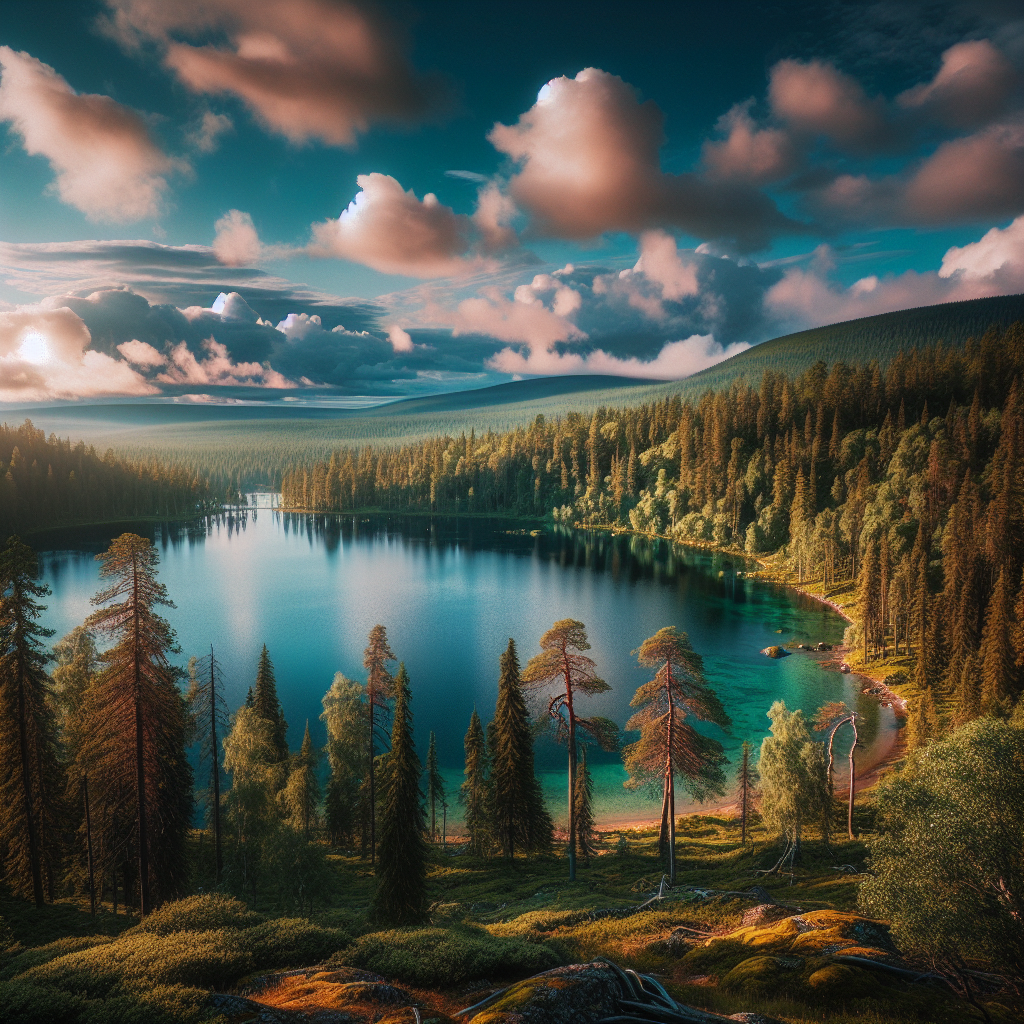
Hossa National Park, situated in the heart of Suomussalmi, is a breathtaking enclave where one can truly connect with the tapestry of human history. Recently, my companions and I embarked on the 8-kilometer (4.9-mile) Värikallio Curve trail, renowned for its ancient rock paintings. Before setting off, we stopped by the Hossa information center for a quick briefing before making our way to the trailhead. Being late August, the warmth of summer lingered, yet the vibrant hues of autumn had yet to arrive in the sprawling pine forest that enveloped us.
Värikallion Curve Trail
After a short drive, we arrived at the expansive parking lot near the trailhead. Opting to go counter-clockwise on the circular route, we found ourselves navigating an initially uneven pathway peppered with roots. However, as we continued, sections of the trail revealed a gentle layering of gravel, making it easier to stroll and immerse ourselves in the lush, dense forest that unfolded around us.
Though we anticipated some elevation changes, Värikallion Curve certainly kept us on our toes. A few kilometers in, we encountered the first set of stairs, which provided only mild huffing and puffing. Shortly after, we reached a significant junction where several paths converged. A note of caution: it’s easy to lose track, so be sure to remember which trail you’ve taken.
As we pressed on, we navigated a few boggy patches, aided by strategically placed duckboards. We passed the Ala-Ölkky lean-to—briefly stopping for its restroom facilities—before following a trail that wound up into the hills, skirting beautiful ponds along the way.
Eventually, we found ourselves on towering cliffs that overlooked a stunning deep blue canyon lake. It required a vigilant eye to stay on the trail and maintain a safe distance from the edge; none of us fancied a tumble into the depths below.
After about 1.5 hours of hiking, we reached a rest area situated next to the rock art cliffs. It was the perfect spot to take a breather, savor some sandwiches, and bask in the sun glinting off the lake.
Incredible Rock Art at Värikallio
The Värikallio Curve trail leads you to the awe-inspiring rock art adorning the cliffside. Experts believe these paintings date back to the Stone Age, roughly 3,500 to 4,500 years ago, likely created by artists working from boats or even while the ice still gripped the landscape.
This waterway was a vital resource for ancient populations, providing one rationale for selecting this cliff face as their canvas. The echoes that resonate from many such sites may have added to its allure, with theories suggesting that these paintings served spiritual purposes—whether relating to shamanism, hunting magic, or prayers for fertility and safe childbirth.
The depictions of moose and the unique human figures—especially those with triangular heads—are rare finds in Finland. Crafted from red and yellow earth heated into iron-rich clay, these artworks were further enhanced with mixtures of blood, fat, or egg yolk.
Hossa Keeps You Fit
After an absorbing exploration of the rock art, we began our return journey to Lihapyørre. The trek commenced, naturally, with stairs—ascending from the lake back to the cliff tops. A true workout, granted!
One aspect that struck us while hiking in Hossa was the pristine air quality. Towering old pines, draped in “old man’s beard” lichen, signaled a clean atmosphere (nava in Finnish).
For those unfamiliar, the presence of beard lichen indicates exceptional air purity, thriving only in areas free from pollution.
You might wonder why we became so curious about the lichen. Well, a moment of rest required us to sit on a fallen log, granting us ample opportunity to observe the surrounding flora.
Once our legs recovered from the beckoning steps, we were pleased to find that the remainder of the trail to Lihapyørre was relatively level. A gentle stretch session is highly advisable upon reaching your vehicle or campsite. Though 8 kilometers might seem manageable, the varied terrain, along with the ascent and descent, demands a solid fitness level—taking breaks is essential.
Directions to Hossa National Park
Getting There: Hossa National Park is expansive, but ideally, you should start at the nature center. The easiest way to reach this gem is by car; simply input Hossa nature center into your navigation system, or use the precise address: Jatkonsalmentie 6, 89920 Suomussalmi.
- By Car: Ample parking is available at the Hossa nature center.
- Bicycle: Biking is an option, though you’ll share the roads with vehicles.
- Public Transport: A seasonal bus service runs to Hossa between weeks 23-39 (June to mid-September). For additional schedules, check here. Outside of this period, a bus travels to Peranka village, 40 kilometers away from Hossa, from which you’ll need to arrange your own transport.
Värikallion Kaarros Trailhead: For those choosing our route, it starts at “Lihapyørre,” where parking is provided. The access road branches from Pistonlehdontie 194, which can be located by entering Värikallio curve into your navigation device. Should you have any doubts, it’s always wise to stop by the visitor center for directions, just as we did.
Accessibility: While the national park is extensive, accessibility may vary. The nature center is wheelchair accessible, but some trails could pose challenges for very young children or individuals with limited mobility.
Facilities: Hossa National Park is open year-round. The Hossa nature center operates typically from 10 AM to 4 PM, though it is closed in January and February. Along the Värikallion Kaarros route, facilities include an outhouse, a cooking hut, a woodshed, and a circular fire pit at Somerjärvi lake. However, be aware that if a forest fire warning is in effect, campfires cannot be used in areas lacking proper ventilation.
When to Visit: The best time to explore is when snow cover is minimal, as deep snow can conceal potential hazards on the trail.
Maps: Trail maps are available on the official National Parks website.
Nearby Attractions
While in the region, don’t miss out on the Silent People art installation, the Musical Forest in Suomussalmi, Riisitunturi Fell for its breathtaking views, and Hepoköngäs waterfall, the tallest in Finland. Also worth investigating are the historic Kajaani tar channels and ruins of old castles, as well as the wonders of Rokua National Park.