

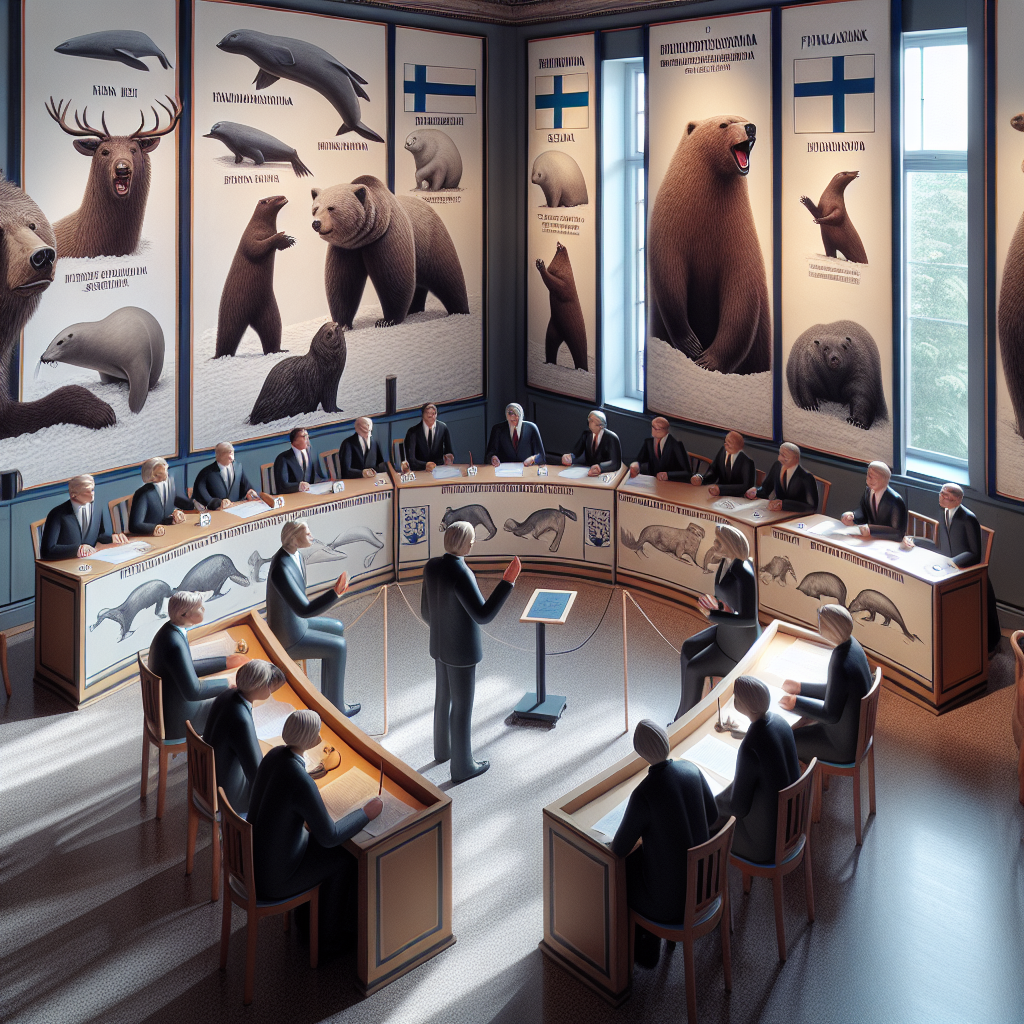
Could Finland’s National Animal Be Due for a Change?
In 1985, the brown bear was crowned as Finland’s national animal following a public vote, but the question now arises: is it time for a shift?
Heini Utunen, the regional director of South Savo, advocates for the Saimaa ringed seal to take that honor instead. This charming creature, endemic to the region, has become the focal point of conservation efforts in recent years, not to mention a beloved subject of live-streamed events that have captured the hearts of many.
The original vote that declared the bear Finland’s national animal was organized by the newspaper Helsingin Sanomat in conjunction with the Finnish Association for Nature Conservation. Out of about 23,000 participants, the bear emerged victorious, with the Saimaa ringed seal coming in as a close second.
“After 40 years, it might be a good time to reconsider,” Utunen remarked in an interview with Yle.
Though she does not plan to formally propose a change, Utunen believes the topic deserves more public discourse. “The seal brings people together in a way that I rarely see with other things,” she noted, emphasizing the positive associations the seal has on the global stage.
Indeed, the South Savo local council recently selected the Saimaa ringed seal as its regional animal, and since then the council has received heartfelt responses from around Finland, commending their efforts to shed light on this endangered species. This wave of support led Utunen to ponder Finland’s choice of national animal.
She pointed to several compelling arguments for making a switch: the significance of environmental issues today, the Saimaa ringed seal’s status as a uniquely Finnish species, and the widespread public backing for its protection. Additionally, she highlighted the need to reconsider the somewhat contentious perceptions surrounding bears.
A recent study even identified the Saimaa ringed seal as Finland’s only native mammal, emphasizing its uniqueness. As Utunen puts it, “Nowadays, environmental values, nature conservation, and the symbiosis between humans and animals are better understood than in the 1980s. They are even part of our school curricula. That’s why it’s important to highlight endangered species.”
Conversely, bears often invoke fear. They are typically viewed as predators, and even the Finnish Wildlife Agency has begun offering training courses to inform citizens on how to handle bear encounters in the wild.
“The Saimaa ringed seal, on the other hand, is perceived as a peaceful animal that poses no threat,” Utunen highlighted.
Another point she raised was the shared identity of the bear with Russia, prompting the question: “Do we want to associate ourselves with that? The bear is also the national animal of Russia, so we might consider whether we want to be in that group.”
Across the globe, national animals often include symbolic creatures such as lions and eagles. Scotland takes a unique approach with the unicorn, representing purity and power since the 12th century.
Calls for the reexamination of national symbols are not new in Finland. There have been repeated attempts to change the national anthem from “Our Country” to Jean Sibelius’ “Finland,” with two separate citizens’ initiatives submitted in 2014 and again proposed for 2024.
A review of public sentiment on Independence Day a few years ago indicated little desire for such changes, yet the conversation surrounding national identity and its symbols continues to evolve.
As discussions unfold, one cannot help but wonder if the Saimaa ringed seal is poised to make a splash in the hearts of Finns as their national emblem.
Finland’s Established National Animals
- National animal: Bear
- National bird: Whooper Swan
- National horse: Finnhorse
- National insect: Seven-spot ladybird
- National fish: Perch
- National dog: Finnish Spitz
- National butterfly: The Holly blue
While not all of these are officially designated national symbols, their status has been widely accepted over the years.