

While many children harbor a fear of the dark, Juhani Karila stood apart; his fear was of light. Growing up in a secluded corner of a tiny village in eastern Lapland, he was the boy who thought the flicker of light in the endless winter darkness signaled an alien presence.
“I had just read about alien abductions in a Reader’s Digest article, and I was convinced they’d come for me to harvest my kidney,” Karila recalls now, over two decades later. “Every time I spotted a light, I figured it must be an alien spaceship. Really, it was probably just a neighbor on a snowmobile.”
In the outskirts of a sparsely populated village, the stark yet expansive landscape fueled Karila’s youthful imagination. “Lapland isn’t exactly like a tropical jungle bustling with activity,” he explains. “I had to rely on my head to entertain myself.”
“Outside my bedroom window, there was just a quiet, dark forest. I populated it with whatever creatures I liked.”
Wringing Out Words Like Dishcloths
Juhani Karila never aimed to pen a tourism brochure for Lapland. His novel, Fishing for the Little Pike (titled Summer Fishing in Lapland in the UK), is anchored in authentic experience.
Karila’s ability to weave stories emerged early on. He began crafting tales and ambitious war novels before he even turned ten, always declaring his intention to become an author. Yet when it came time for career choices, his mother insisted on a more practical education.
He pursued journalism in Tampere, wrote for various newspapers, yet his love for fiction never flickered out. One of his short stories even earned a prestigious literary award, and he published two collections. His unique style fused the enchanting elements of magic realism with a straightforward Finnish sensibility, yielding language that is both dense and expressive.
“If a sentence is like a wet dishcloth, I wring out the water, trimming any excess words,” he explains, referencing another author’s description of his prose as ‘huh prose’—a mixture of awe and intrigue. “In my first collection, Gorilla, I took that to the extreme. It’s still there, but my recent works have started to breathe.”
From Fishing to Success
Juhani Karila chose journalism as a conduit for his writing ambitions.
Yet, after two collections, Karila found himself in a dry spell of inspiration. Relocating to the capital city left him feeling unmoored, prompting nostalgic reflections on his childhood fishing trips in Lapland’s wilderness with his father.
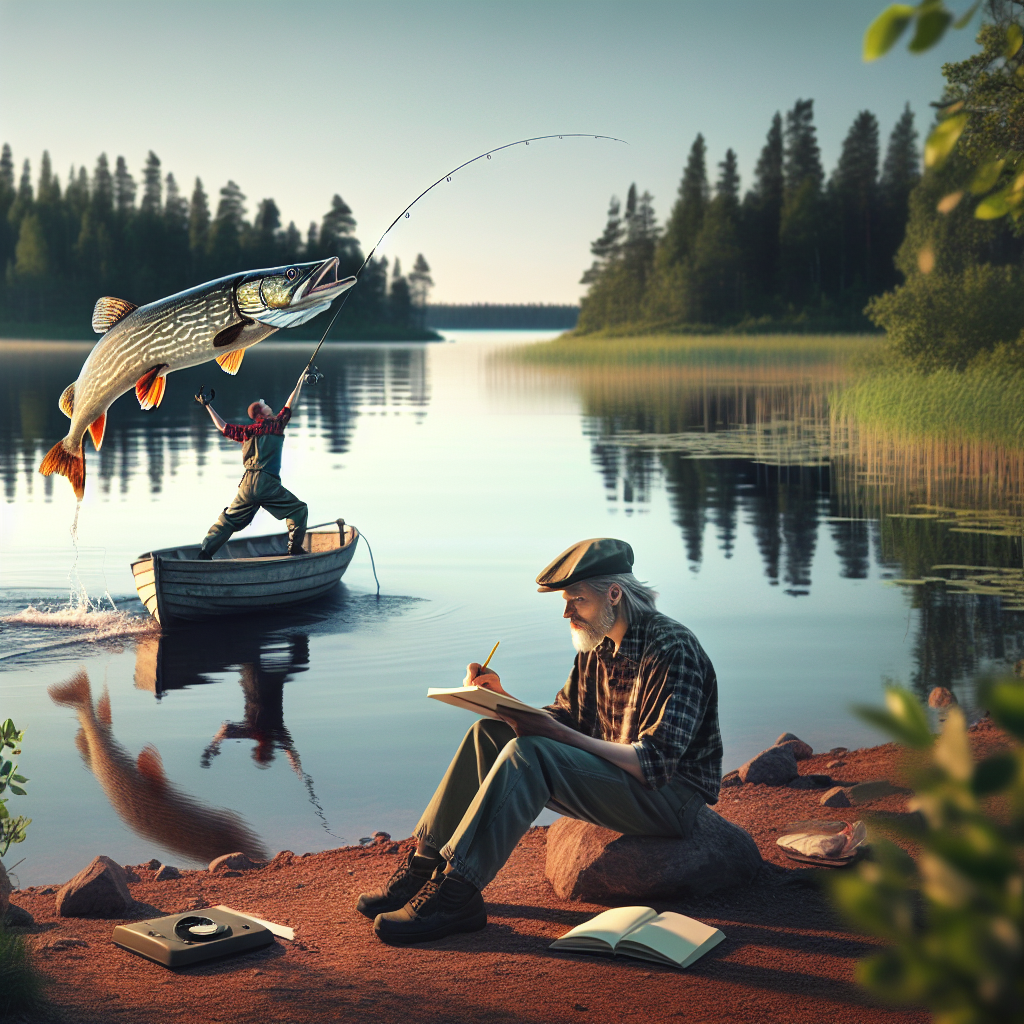
It was time for a longer narrative. He began crafting a story revolving around the annual ritual of catching a specific pike each summer. Though the reason behind this curious practice remained elusive, he trusted the writing process would unfold the answers.
And unfold it did. His debut novel, Fishing for the Little Pike (or Summer Fishing in Lapland in the UK), was published in Finnish in 2019. The book, a rich tapestry of real-life descriptions of Lapland and its fantastical inhabitants, exploded in popularity—it has since been translated into over twenty languages, garnered several awards, and has inspired stage adaptations, along with a film in the works.
While Karila was pleased, he wasn’t entirely surprised. He had felt the quality of his writing even as he worked on it.
When he shared the first hundred pages with his partner, he anticipated accolades. Instead, she posed a provocative question: why was the protagonist male? Why were those battling the forces of nature invariably men?
Karila was taken aback, arguing that changing the character’s gender would alter the entire narrative. “She looked at me with pity and suggested I only needed to change the name,” he recalls, dismissing her insight as naive. Yet, when he took her advice, he was astonished to discover it transformed the story into a fresh perspective—one free from the male gaze.
More in the Making
Karila’s first novel, Fishing for the Little Pike, has reached audiences beyond borders with its translation into over twenty languages and adaptations for theater.
During the writing of Fishing for the Little Pike, Karila made several trips back to his childhood home, eager to recapture the sensation of wandering through the wetlands of his youth. He found himself frequently calling his parents, who began to wonder why their son was suddenly so keen to reconnect.
“I never wanted to hang up,” he says. “I was drilling them about dialects, gathering their phrases. I was absorbing their expressions.”
As the novel’s translations multiplied, so did the challenges of maintaining its linguistic nuances. Finding suitable equivalents for distinctly Lapland terms became an intricate puzzle, particularly when working with one particularly meticulous translator who challenged every inconsistency in the text.
However, the translators may soon face another challenge with Karila’s upcoming work. While he remains tight-lipped, he assures that his second novel will land next autumn, once again showcasing the unique brand of ‘whoa prose’ that has come to define his writing.
By Anne Salomäki, March 2026; photos by Emilia Kangasluoma