

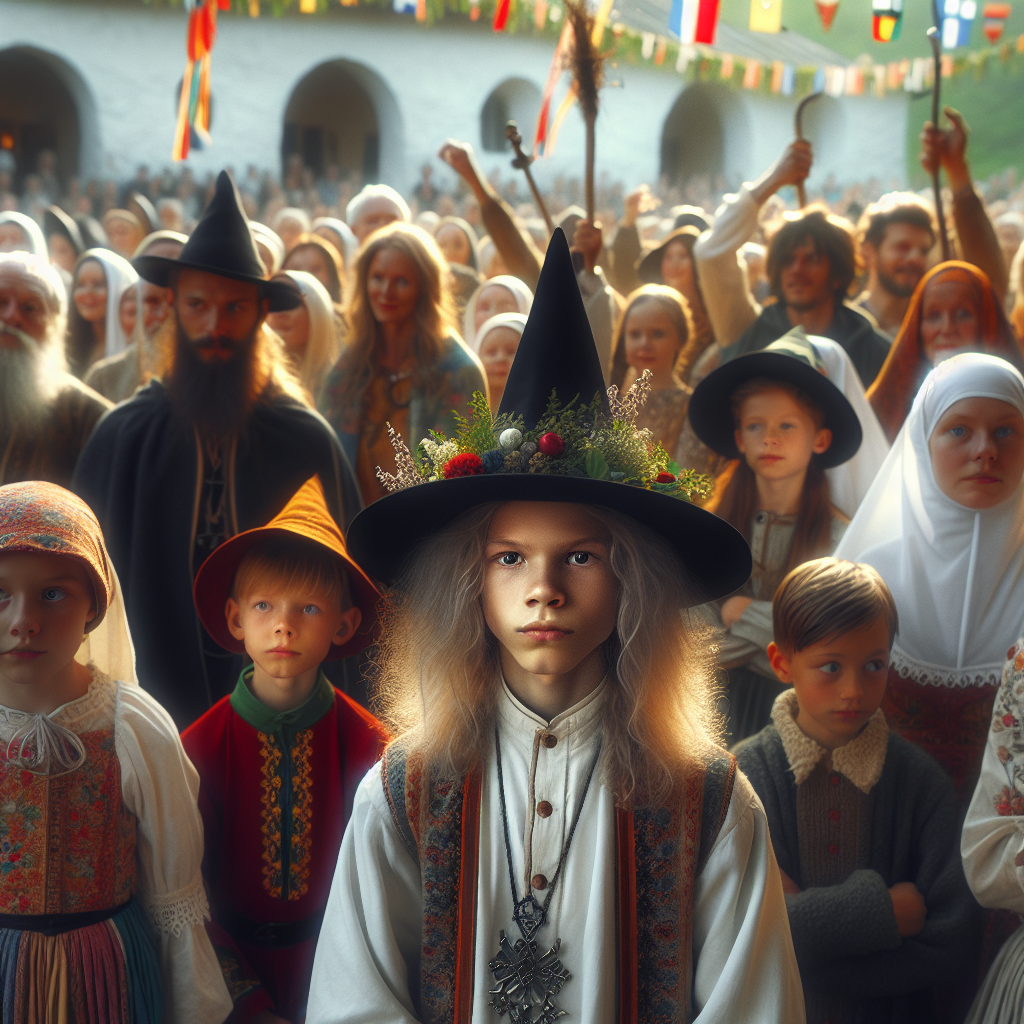
A lively band of children eagerly approaches a house in a neighborhood near Helsinki, their excitement palpable as they ring the doorbell. The door swings open to reveal a friendly neighbor, all smiles.
With a courteous nod, the children launch into a traditional rhyme, waving freshly decorated pussy willow branches in the air. Their verse, a charming wish for health and happiness in the year ahead, concludes with a cheeky twist:
“My toe is fresh, fresh and healthy, for the coming year, joke to you, salary to me!” (The translation: I wave a twig for a fresh and healthy year ahead; a twig for you, a treat for me!)
One by one, they proffer their branches, and the homeowner reciprocates with handfuls of sweets into their waiting baskets.
Ulrike Kivelä carefully applies Easter witch makeup to Felisa’s cheeks.
Little Felisa catches up with some neighbors on her way to the next house.
Easter decorations are already in full display; the Easter egg, a symbol of life and rebirth, stands out among the vibrant adornments.
Easter in Finland is a celebration steeped in Christian tradition, yet the rituals here uniquely intertwine ancient folklore with the joyous arrival of spring after a long winter.
Homes spring to life with colorful symbols of renewal—daffodils, fresh Easter grass, and hand-painted eggs. However, the highlight for many comes on Palm Sunday or Holy Saturday, when children across the country don witch costumes and traverse their neighborhoods, offering blessings and decorated willow branches in exchange for sweets.
This year, we joined a lively group of local children in the Lippajärvi neighborhood of Espoo, just west of the capital, to witness this cherished tradition in action.
The children exhibit no shyness as they eagerly ring the doorbell.
The day has been fruitful; baskets fill up with sweets, and a number of houses still await visits.
In the spirit of Easter, the family dog sports a cute pair of bunny ears while Emily, 5, embraces her witch persona.
At the German-Finnish Kivelä household, the day kicks off with a flurry of activity. Mother Ulrike Kivelä assists Felisa, 3, and Tapio, 7, as they settle into their costumes. Felisa’s cheeks are painted rosy, adorned with playful freckles, while Tapio dons a whimsical wizard’s mustache and beard.
Though the family is set to fly to Germany for Easter, Ulrike intentionally scheduled a late flight, ensuring her children could fully engage in this Finnish custom. “Creating these memories is vital for them,” she emphasizes.
Before heading out, the children gather with neighborhood friends. Viljo, 8, and Ivo, 5, are also dressed as witches, ready for their exciting adventure. Their mother, Daria Dunajewdka, carries a bundle of beautifully decorated willow branches crafted with care by the children themselves. Viljo, in particular, has taken great joy in personalizing them—”for him, the decoration is even more exciting than the chocolate reward,” Daria shares.
Ivo, Felisa, and Viljo greet residents with wide smiles. In this friendly community, neighbors are prepared for their Easter guests.
Friends Ella, 9, and Ida, 9, have a clever strategy: at each door, they present two branches to double their loot.
Little witches rush off to their next destination.
This door-to-door tradition, known as shaking—the act of wishing happiness with a willow branch—is a vibrant testament to cultural evolution. Its origins lie in eastern Finland, where the custom of blessing neighbors with willow branches draws inspiration from Gospel accounts of Palm Sunday.
The costumes, representing witches, stem from western Finnish folklore, reflecting historical beliefs that witches and malevolent spirits roamed freely during Easter. To ward them off, spells were cast and bonfires blazed. Over time, this practice merged beautifully with the blessing ritual, culminating in children dressed as witches sharing their joyful wishes.
As the group trips to the door of their kindergarten teacher, they find most visits are to familiar faces in this welcoming neighborhood. The smiles that greet the little witches suggest they are beloved visitors, and the growing heaps of sweets in their baskets indicate they were expected with delight.
A decorated willow branch is exchanged for sweets, typically chocolate eggs and various Easter treats.
Brothers Samuel, 3, Mikael, 7, and Simeon, 5, finish their rounds but must wait until lunch is over to enjoy their candy haul.
Lilian, 10, hurries to the next house, trying a new costume this year instead of her usual witch outfit.
The lively streets are soon filled with more children, many in traditional witch costumes, but some stand out as chicks, bunnies, a dinosaur, and even a Moomin character, Little My—a beloved figure from Finnish author and artist Tove Jansson’s famed series. This eclectic array of costumes reflects the evolving nature of the tradition. The children momentarily pause to compare their treasures before eagerly darting off again, their youngest companion, Felisa, struggling to keep pace.
As their route nears its end, the suggestion of heading home prompts a chorus of protest: “Not yet, not yet!” Only when the last branch has been offered do they relent, their baskets brimming with sugary loot.
For these cheerful little witches, the day’s adventures have undeniably been a success.
Text by Ilona Koskela, photos by Mikko Suutarinen, April 2026