

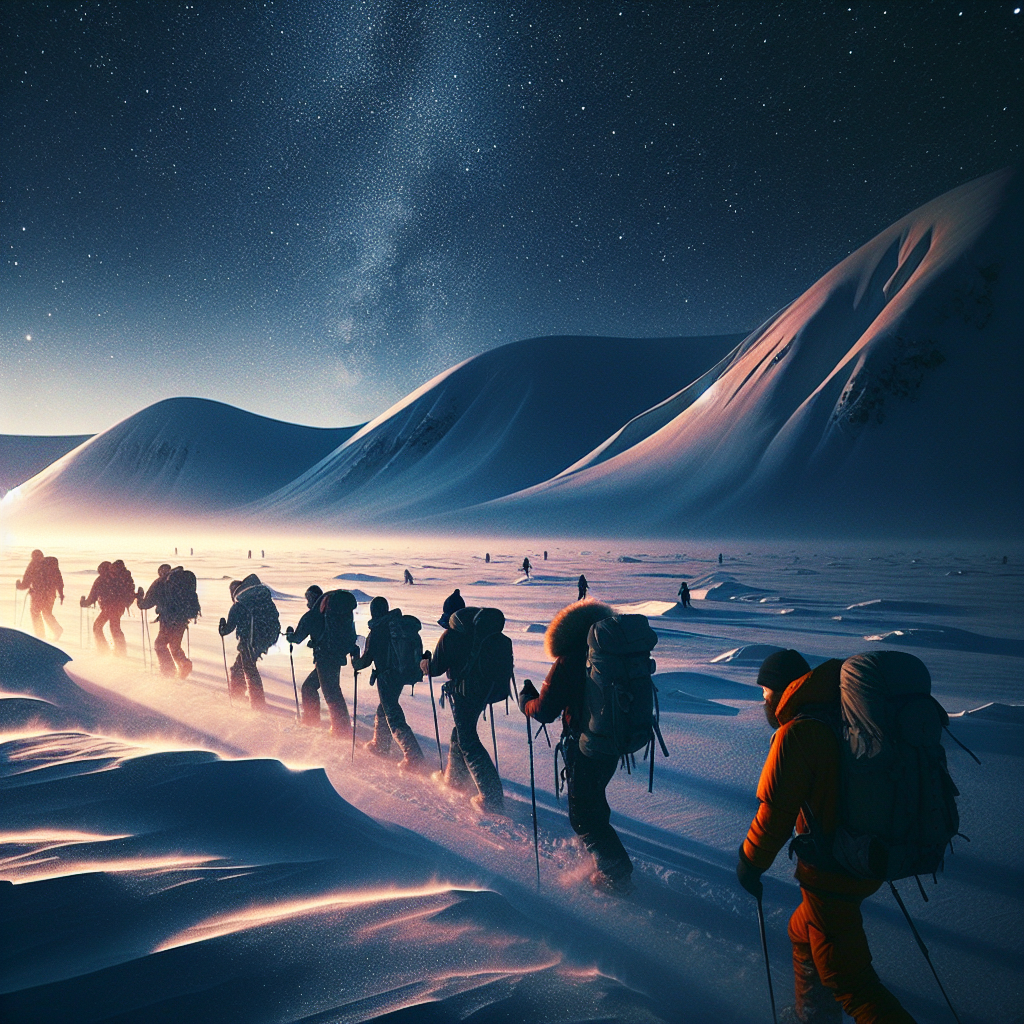
Even with snowshoes strapped to my feet, I find myself sinking knee-deep into fresh powder. Each step feels like a laborious endeavor, the weight of my heavy backpack a constant reminder of the journey ahead.
As the temperature hovers around minus 20 degrees Celsius (minus four degrees Fahrenheit), the sun struggles to peek over the horizon. It is one of the bleakest days of the year in Oulanka National Park, in the northern reaches of Finland.
Yet, amid the chill and darkness, I sense that this is precisely the moment meant for a polar-night hike.
Kiutaköngäs, nestled in northern Kuusamo, is a breathtaking stretch of rapids, a sight that captivates visitors throughout every season.
The Finnish Wilderness huts, while often bare-bones, provide a warm refuge for all. At our Hut by the Oulanka River, a generous supply of firewood awaits – splitting it becomes a welcome warmth against the biting cold.
It’s courteous to leave at least one basket of chopped firewood at the Wilderness Hut for those who follow.
Interpreting the Winter Landscape
Reindeer tracks crisscross the snow, silent witnesses to those who have journeyed here before us. Each footprint narrates its own story on this cold canvas.
In the distance, the powerful sound of rushing water disrupts the stillness. Even the fiercest frost cannot contain Kiutaköngäs, where the Oulanka River flows with vigor, while other parts are sealed beneath a thick layer of shimmering ice.
The forest, too, has its voice. Trees crack and moan in the cold, the eerie sounds igniting the imagination. Was that a movement behind that spruce? My breathing slows as I succumb to the stillness, listening intently.
In this enveloping darkness, my imagination roams. Are there reindeer watching from a distance, or perhaps something even more mysterious?
The air bites back with a stinging cold, and long strands of pale lichen hang heavily from the branches of pines. Recent storms have toppled several trees, leaving me to wonder: Are we still on the right path? A gnawing hunger reminds me of the chocolate buried in my pocket – solid, but a welcome treat nonetheless.
A lingering twilight cloaks the landscape. The sky morphs into a soft pink, transitioning through myriad shades of blue. When darkness finally descends shortly after noon, stars and the moon illuminate the snow, making it feel as if night never truly arrives.
In the wilderness, mobile phones offer little use, and in subzero temperatures, their batteries drain rapidly. This unique circumstance allows for a refreshing disconnection from the digital world.
Before spring’s sun begins to shimmer on the snow, nature embraces a profound quietude. In the depths of midwinter, only a handful of intrepid explorers venture outside.
Dressing in layers is crucial in these frigid conditions. A breathable wool or merino wool base is essential, layered with additional insulation and capped off with a windproof outer shell. In the dark, a dependable headlamp becomes indispensable.
A Night in a Wilderness Hut
Guided by the beam of our headlamps, we locate our refuge for the night. The Wilderness Hut feels cold and deserted; the guestbook reveals the last visitors were here two months prior. But the flicker of candles and warmth from the stove soon transforms the space into a cozy sanctuary.
Still, chores await.
While firewood is abundant, it demands sawing and splitting to become usable. Lacking a well, we will rely on melted snow for drinking water.
We sit down for dinner, still clad in our woolen hats and winter jackets.
Finland’s national parks boast hundreds of kilometers of trails for hiking during the warmer months. In winter, some routes are maintained, but navigating them relies significantly on luck and skill.
Heating a Wilderness Hut with a wood-burning stove is a labor in itself. Firewood must be used judiciously, as transporting it deep into the fells or forests is both labor-intensive and costly.
On a winter trek, the essentials include movement, warmth, rest, and of course, nourishment. In subzero temperatures, your body’s energy expenditure skyrockets. With running water scarce, melting snow provides an adequate water source.
Wilderness huts designed for overnight stays can be found, particularly in northern Finland. Many have rich histories, having served as shelters for loggers or reindeer herders over the decades.
Finally, we settle in. Cuddled within sleeping bags, we extinguish our headlamps, allowing the candlelight to dance against the wooden walls. Outside, darkness stretches infinitely. But rather than an emptiness, it feels more like a protective embrace.
The return journey feels lighter as we tread back along our own tracks. Until next time, dear forest!
Practical Tips for Winter Hiking in Finland
Understanding the Polar Night
The polar night (or kaamos in Finnish) refers to an annual period when the sun fails to rise above the horizon. This phenomenon occurs within the Arctic Circle, lengthening as one journeys northwards towards the pole. In Nuorgam, Finland’s northernmost village, this night lasts for over 50 days. However, the polar night isn’t synonymous with complete darkness; instead, the midwinter sky often bursts with shifting hues of pink and blue, presenting a kind of twilight. And if you’re fortunate, the mesmerizing northern lights might grace the skies.
The northern regions of Oulanka National Park lie on the edge of the Arctic Circle, where the polar night is an annual occurrence.
Winter Hiking Essentials
Winter hiking is best suited for those with solid experience navigating diverse conditions. Always check weather forecasts and inform someone of your planned route and schedule. Fundamental gear includes a first-aid kit, spare clothing, adequate food, a stove, a headlamp, and a high-quality sleeping bag rated for winter conditions.
In winter, travel occurs primarily on skis or snowshoes, with gear carried in a backpack or, more commonly, pulled on a sled known as a pulk in English and ahkio in Finnish.
For beginners, day trips provide an excellent opportunity to build experience. Late winter often affords more manageable conditions than midwinter: the snowpack typically offers better support, and daylight lingers later into the afternoon.
Exploring Trails, Parks, and Huts across Finland
Finland boasts an expansive network of marked trails, and all 41 national parks are accessible year-round at no charge. It’s important to review local regulations, as camping is generally restricted to designated areas. Many parks feature shelters and Wilderness huts for overnight stays.
Hut etiquette is simple: make room for newcomers, leave behind chopped firewood, and ensure the hut is at least as clean as you found it. More information about Finnish national parks and huts can be found online at Luontoon (“into nature”).
Text and photos by Emilia Kangasluoma, February 2026