

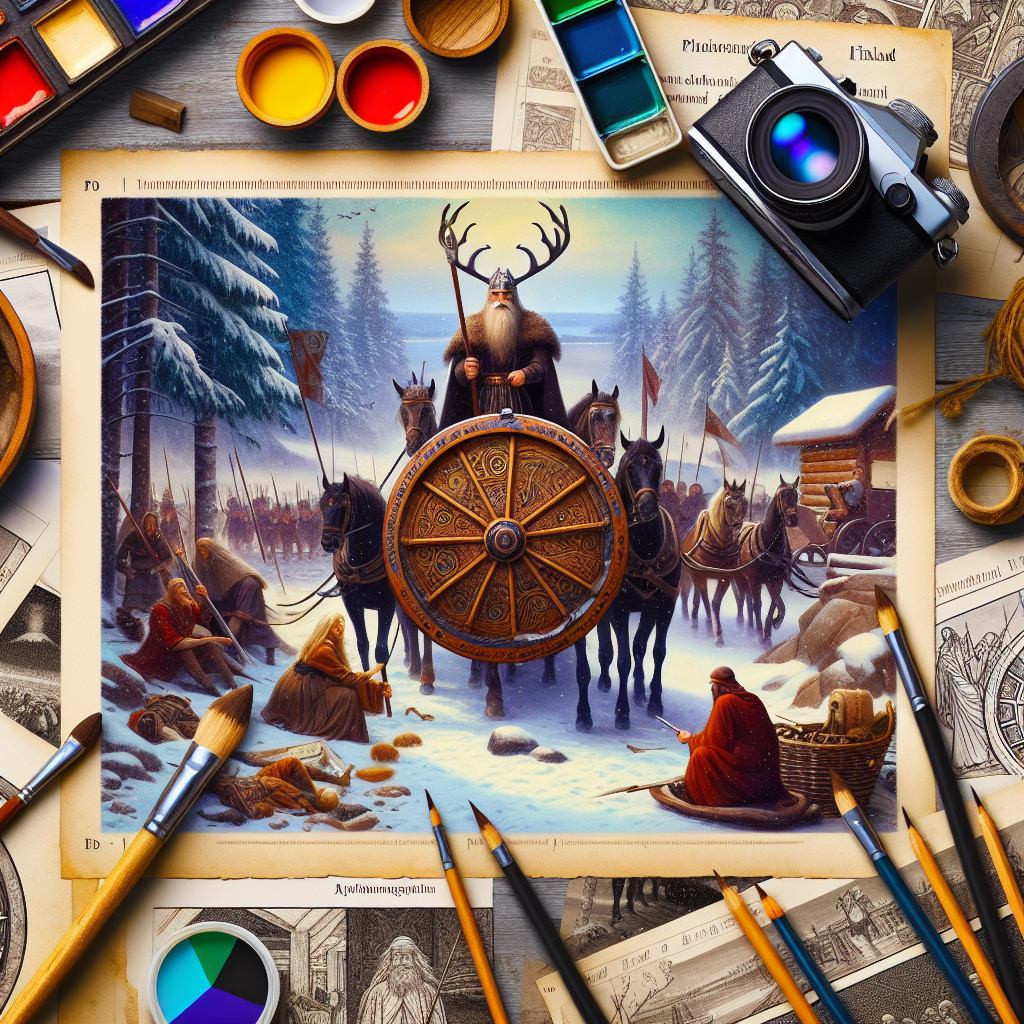
What is the Kalevala?
The Kalevala stands as a monumental piece of epic poetry, a tapestry woven from centuries of Finnish and Karelian folk songs. Compiled and edited by the Finnish scholar Elias Lönnrot, this national epic first appeared in its final form in 1849 and remains a cornerstone of Finnish culture.
Rather than being crafted entirely anew, the Kalevala draws deeply from the oral traditions of its people. The cultural and geographical region of Karelia, which now straddles eastern Finland and northwestern Russia, provided a rich backdrop for Lönnrot’s collection of verses.
During his travels across eastern Finland and Karelia, particularly in White Sea Karelia, Lönnrot gathered fragmented songs and ancient myths, piecing them together into a cohesive narrative. An earlier edition known as the Old Kalevala was published in 1835. The expanded New Kalevala of 1849 comprises 50 poems or chapters, totaling over 22,000 verses that resonate with the distinctive trochaic rhythm known as the Kalevala meter.
In Finland, February 28 is celebrated as Kalevala Day, a tribute to Finnish culture.
Who is behind the Kalevala?
Portrait of Elias Lönnrot, a key figure in Finnish culture, circa 1850. Photo: Finnish Heritage Agency
The mastermind behind the Kalevala is Elias Lönnrot (1802–84). A physician, linguist, editor, poet, and later a professor of Finnish language, Lönnrot’s life story is one of remarkable ascent from humble beginnings in the village of Sammatti in southern Finland.
With a burning passion for folk poetry, Lönnrot set out in 1828 to collect songs and narratives from eastern Finland, Karelia, and even regions well north of the Arctic Circle.
While he initially aimed to recover ancient poetry, Lönnrot’s role transcended mere documentation. He rearranged, modified, and composed linking passages, crafting a narrative that resonates with coherence. Remarkably, only about 3 percent of the text was penned by Lönnrot himself. Thus, the Kalevala emerges as both a celebration of folklore and a carefully constructed literary work.
Central to Lönnrot’s mission was the promotion of the Finnish language. In 1831, he co-founded the Finnish Literature Society, a pivotal organization in preserving Finland’s cultural heritage.
The genesis of the Kalevala
Anders Ekman’s depiction, Väinämöinen Stringing his Kantele (1855). Photo: Finnish National Gallery/Lauri Asanti
Lönnrot’s overarching goal was to safeguard Finnish poetry and elevate the language’s literary status during a time when Romantic nationalism was sweeping through Europe. This intellectual tide encouraged nations to delve into their folklore and oral traditions, gradually shaping the notion of a unified epic.
Finland’s status at the time was complex; it had transitioned from being part of Sweden for centuries to becoming an Autonomous Grand Duchy within the Russian Empire in 1809. The burgeoning national movement of the 19th century sought to cultivate a distinct Finnish identity, driving Lönnrot’s mission.
Inspired by the likes of Homer’s Iliad and Odyssey, Lönnrot envisioned how disparate folk verses could be woven into a cohesive narrative. The late 18th century had ignited a broader interest across Europe in national epics and folk traditions, influenced by works such as the Nibelungenlied and the Edda. Earlier folklorists like Christfrid Ganander and Zacharias Topelius had already begun this vital work.
In this context, the Kalevala emerged as a powerful emblem of a people rich with history, mythology, and a unique voice, even though much of its material was gathered in Karelia.
Lönnrot harmonized various dialects of southeastern Finnish and Karelian language, crafting new plotlines and characters while standardizing the verses’ meter. His work was not merely archival; it involved creative selection, moral refinement, and imaginative transformation, rendering the poetry more accessible to contemporary Finnish readers.
The narrative of the Kalevala
Joseph Alanen’s artwork, The Defense of the Sampo (1910–1912). Photo: Finnish National Gallery/Jenni Nurminen
Diving into its contents, the Kalevala offers a sprawling tapestry of myths and adventures. It begins with a captivating creation story, where a wild duck lays its eggs upon the knee of the primeval maiden of the air. When the eggs fall and shatter, their pieces form the earth, sky, sun, and moon.
At the epic’s core lies the rivalry between the land of Kalevala and the northern realm of Pohjola. Their clash centers around the Sampo, a mystical object believed to bring abundance, forged by the blacksmith Ilmarinen and subsequently fought over at sea.
Magic, feuds, love, revenge, and loss permeate its narrative, yet its themes resonate with contemporary concerns: the autonomy of women to choose their partners (illustrated by the tale of Aino) and the complex relationships between parents and children (as seen in the story of Kullervo). The arc of the narrative culminates in the advent of Christianity, symbolizing the transition from the mythical to the historical age.
The key figures in the Kalevala
Akseli Gallen-Kallela: Kullervo Cursing (1899). Photo: Finnish National Gallery/Hannu Pakarinen
The cast of the Kalevala is rich and varied, with memorable characters such as:
- Väinämöinen, the wise old singer and cultural hero wielding the power of magic through song
- Ilmarinen, the master blacksmith renowned for forging the Sampo
- Lemminkäinen, a reckless adventurer exuding charm
- Lemminkäinen’s mother, a powerful figure embodying selfless devotion, ever-ready to aid her son
- Louhi, the formidable matriarch of Pohjola
Other significant figures include Aino, whose tragic fate catalyzes the story’s progression, and the tormented Kullervo, whose dark tale of vengeance echoes throughout the epic.
Kullervo’s psychologically complex narrative, marked by themes of betrayal and tragedy, captivated J.R.R. Tolkien, who studied Finnish and retold Kullervo’s story in his own work, The Story of Kullervo.
The legacy of the Kalevala
Robert Wilhelm Ekman: Ilmtar (1860). Photo: Finnish National Gallery/Aleks Talve
Upon its publication, the Kalevala quickly became a national treasure for Finland and Karelia, catalyzing cultural and scholarly endeavors. It played a crucial role in promoting the Finnish language and contributed to the national identity that ultimately led to Finland’s independence in 1917.
Its impact reached far beyond literature; the imagery and themes of the Kalevala shaped the realms of art and architecture, inspiring iconic depictions by painter Akseli Gallen-Kallela and influencing composers like Jean Sibelius.
Why is the Kalevala still relevant today?
Carl Eneas Sjöstrand: Lemminkäinen (1872). Photo: Finnish National Gallery/Henri Tuomi
The epic continues to ignite the imagination of artists and creators. Its influence is palpable in contemporary comics, children’s literature—including Mauri Kunnas’s playful rendition, Canine Kalevala—as well as in film and music. Recent adaptations include the film Kalevala: The Story of Kullervo, directed by Antti J. Jokinen.
Bands like the folk ensemble Värttinä and the metal group Amorphis have drawn from its mythic themes, while names inspired by the Kalevala endure in Finnish culture—streets such as Sammonkatu (Sampo Street), neighborhoods like Tapiola (named after the forest god Tapio), and given names such as Aino, Väinö, and Ilmari remain commonplace.
Can you discover the Kalevala in other languages?
Akseli Gallen-Kallela: The Aino Myth triptych (1891). Photo: Finnish National Gallery/Aleks Talve
Indeed, the Kalevala has transcended language barriers, having been translated into over 60 languages, including multiple English versions, thus making its rich narratives accessible to readers across the globe.
The Kalevala at a glance
Akseli Gallen-Kallela: Lemminkäinen’s Mother (1897). Photo: Finnish National Gallery/Hannu Pakarinen
What is it?
The Finnish and Karelian national epic—a collection of mythological poems derived from oral tradition.
Who compiled it?
Elias Lönnrot (1802–1884), a physician, linguist, and folklorist.
When was it published?
- Old Kalevala: 1835
- New Kalevala (definitive version): 1849
How was it created?
Elias Lönnrot gathered centuries-old oral poetry from eastern Finland and Karelia, editing this wealth into a unified epic.
What themes does it explore?
Creation myths, rival realms, magic, heroes, and tragedy.
Why is it significant?
The Kalevala shaped Finnish national identity, inspired countless artists, and left an indelible mark on cultural history, influencing figures like J.R.R. Tolkien.
Can you read it in English or other languages?
Yes, it is available in more than 60 languages worldwide.
For further exploration of the Kalevala, visit the Kalevala Society’s website.
By Emilia Kangasluoma, February 2026