

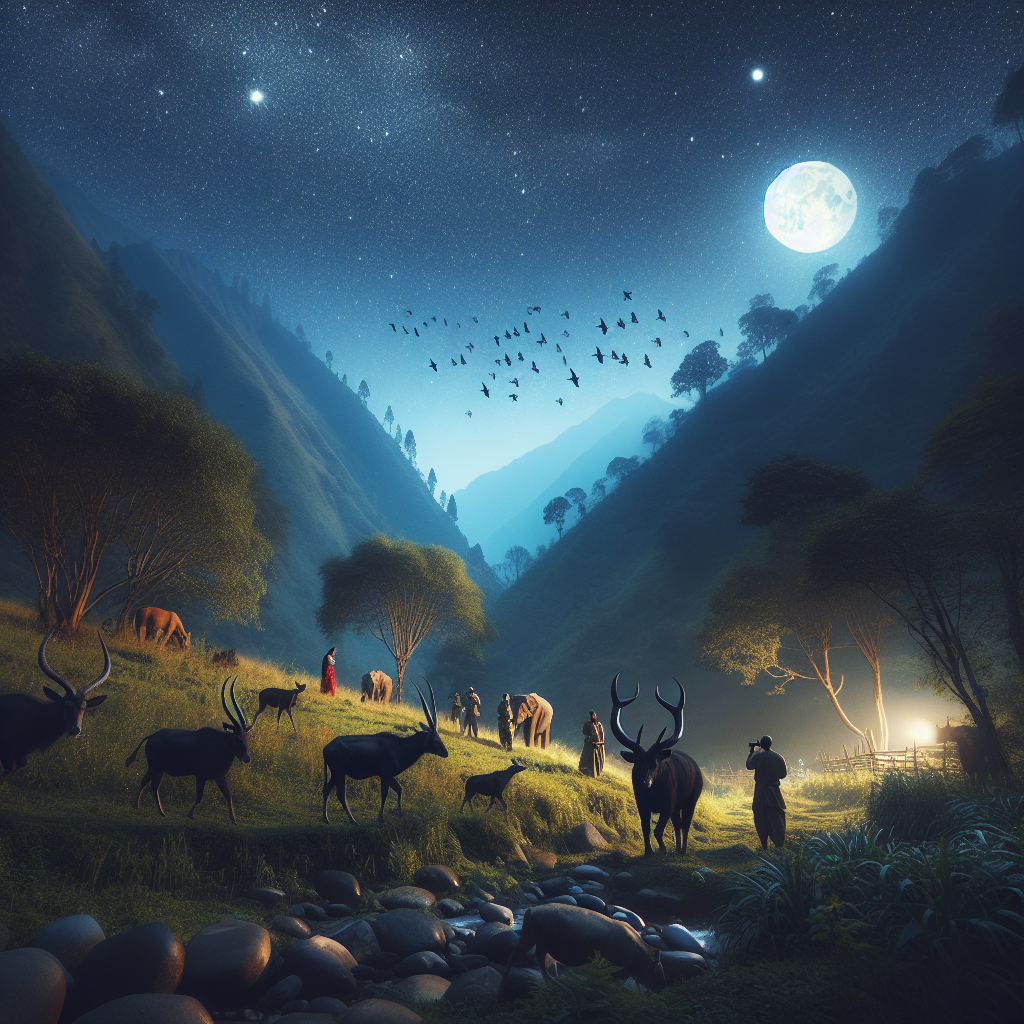
The spot lamp cuts through the darkness as the Land Rover lumbers forward, sending the unmistakable aroma of the African bush swirling in the cool night air. Within the circle of light, I catch fleeting glimpses of mopane and acacia trees, gently rustling grasses, and the languid ripples of the Lubi River. I lean forward, my eyes straining into the inky blackness, eager to find those telltale twin pinpricks of light.
Then, suddenly, two green-yellow spots appear above, revealing a glimpse of mottled fur. Could it be? No—the eyes are just a bit too far apart. With the hum of the engine fading away, we draw to a stop, breathless.
Our spotter deftly directs the beam toward those unblinking gleams. And there she is, lounging on a branch with a nonchalant grace that only a leopard can manage. Her eyes remain locked on us—not defensive, not shying away—just comfortably regal under the stars. At last, I remember to breathe.
Encountering such a magnificent predator in the wild—like I did in Zambia’s South Luangwa National Park—is exhilarating enough during daylight. But when the darkness wraps around you, that thrill intensifies exponentially.
Perhaps you’ve felt the rush of adrenaline when a deer unexpectedly bounds across your path at night. Or maybe you’ve tracked the elusive flicker of bats flitting through the air. Whether you’ve staked out a badger sett or listened closely for the nocturnal sounds of the wild, you know that watching wildlife after sunset invites you into a thrilling, unfamiliar realm. A realm many nature enthusiasts are eager to explore.
What is Night Tourism?
‘Noctourism’ is on the rise. A recent survey by Booking.com revealed that 62 percent of respondents across 33 countries are considering visits to darker-sky destinations in 2024. Astrotourism—whether chasing eclipses, tracking meteor showers, or gazing at the Aurora—is flourishing.
While many travelers are drawn to the 230-plus dark-sky locations recognized by DarkSky International for stargazing, others are eager to witness the vibrant nocturnal and crepuscular wildlife that thrives after the sun sets.
Which Animals Can You See at Night?
Remarkably, around 69 percent of all mammals are nocturnal to some degree. Two-thirds of invertebrate species also operate primarily in the dark, performing crucial roles in ecosystems—such as moths serving as vital pollinators for night-blooming plants.
The avian world adds an exciting layer, too. Over 200 species of owls come alive once the sun goes down, alongside nightjars, frogmouths, potoos, night herons, and New Zealand’s iconic kiwis. Equipped with nostrils at the tips of their bills, kiwis can detect vibrations from insects lurking just beneath the soil.
Many amphibians and reptiles have adapted to avoid the heat and dangers of daylight. After nightfall, geckos scavenge for insects, while frogs and toads migrate back to ancestral breeding ponds. Astonishingly, six of the seven species of sea turtle emerge onto beaches at night to lay their eggs, with Costa Rica’s olive ridley turtles offering spectacular mass nesting events known as arribadas.
This fervent desire to witness unique behaviors and elusive creatures contributes to the growing popularity of nocturnal wildlife watching.
Why is Night Tourism So Popular?
“In the last five years, there’s been a noticeable uptick in people eager to venture out at night in search of rare mammals,” shares Tom Mabbett, operations manager at Naturetrek. This year, for instance, we’re running multiple trips to Deramakot Forest Reserve in Malaysian Borneo, where we devote hours each night to tracking elusive species like the Sunda clouded leopard.
Yet it’s not merely a quest for novelty. “In the absence of daylight, your other senses sharpen,” says Justin Francis of Responsible Travel. “You become acutely aware of your vulnerability and more attuned to the smells and sounds of the wilderness surrounding you.”
“Nighttime wildlife watching is profoundly immersive,” agrees Ian Loyd, product manager at Wildlife Worldwide. “You’re stripped of distractions and focused intently on the rustling in the bushes or the calls of owls—a rare, exhilarating glimpse into the wild.”
For many, it’s a primal thrill. Megan Eaves-Egenes, author of Nightfaring: In Search of the Disappearing Darkness, recounts her experience trekking for wolves in Italy’s Apennines. “In the pre-dawn hours, we heard wolves howling from several miles away, and the sound swept through the valley like an ambulance siren—it was overwhelmingly powerful. It reminded me of humanity’s ancient anxieties, when we were not the apex predators, but rather the prey.”
Indeed, research indicates that humans experience heightened fear at night, with light acting to dampen activity in the amygdala—our brain’s fear center—rendering nocturnal encounters, especially with predators, all the more spine-chilling.
Adaptations of Nocturnal Animals
Nocturnal species have developed fascinating adaptations to thrive in darkness. Many possess larger eyes populated with more rods—photoreceptors sensitive to light—while having fewer cones that detect color.
A reflective layer behind the retina called the tapetum lucidum enhances light sensitivity, producing the characteristic eyeshine that makes spotting creatures like lions and leopards possible on a night safari. Bats navigate their surroundings using sonar, and certain snakes, such as pit vipers, boast sensors that detect infrared radiation, functioning similarly to thermal imaging. Raccoons exhibit incredibly sensitive paws that aid in foraging during the night.
Other adaptations are simply dazzling. A variety of nocturnal insects and several types of fish, crustaceans, and jellyfish navigate the shadowy depths of the ocean, creating bioluminescent displays through chemical reactions with luciferins. Watching fireflies flicker across a meadow is just one enchanting example.
In New Zealand’s Waitomo Caves, visitors can experience ‘black-water rafting’ beneath a mesmerizing display of glow-worms, the larvae of fungus gnats that attract prey with their bioluminescent light. Equally mesmerizing is the bioluminescence produced by tiny dinoflagellates in certain regions, with Mosquito Bay on Vieques, Puerto Rico, recognized as the brightest bioluminescent bay by Guinness World Records. Gliding through the waters in a kayak here offers an unforgettable visual spectacle.
On Land or at Sea
Aquatic night experiences hold some of the most unforgettable encounters. Snorkelers and divers meet a unique roster of marine life, as many species emerge to feed and breed in the dark.
Various species of sharks—such as the night, zebra, and whitetip reef sharks—are typically nocturnal; the heart-stopping moment when a creature darts through your light beam is indescribable. If you find yourself diving Australia’s Great Barrier Reef on a full moon night, you might witness a remarkable spectacle of coral spawning, as the ocean comes alive with a blizzard of eggs and sperm.
On land, wildlife activities can vary based on predator presence. Throughout East and Southern Africa, night drives reveal not only lions and leopards but also genets, civets, caracals, porcupines, and honey badgers. Occasionally, these outings unfold to unveil the elusive pangolins, aardvarks, or aardwolves.
In Brazil’s Pantanal, the world’s largest tropical wetland, nighttime safaris seek out jaguars, ocelots, giant anteaters, tamanduas, and armadillos.
Walking safaris provide a unique contrast to night drives, particularly in destinations like Sri Lanka, where the focus often centers on the behaviors of smaller felines. “On a recent trip, we quietly observed a male fishing cat hunting, using red-filtered light to avoid disturbing him,” recounts Ian. “He crept to the water’s edge, softly tapping the surface to imitate an insect and lure fish, which he swiftly captured and consumed.”
Night walks in Costa Rica’s cloud forests, where about 80 percent of the animal inhabitants are active after sundown, might reveal glimpses of kinkajous—those charming ‘honey bears’ that reach into blossoms with their long tongues—sloths, toucans, and an array of snakes, insects, and spiders.
Madagascar offers another rich tapestry of nocturnal biodiversity, with species such as the world’s smallest primate, Madame Berthe’s mouse lemur; the Malagasy giant jumping rat, which faces critical endangerment; and the eerie aye-aye, a lemur that uses its elongated finger to extract larvae from wood.
You can also enjoy nocturnal wildlife without venturing far. In Sweden and Finland, hides are designed for overnight observation of brown bears, with occasional wolf or wolverine sightings as delightful bonuses.
Several luxury African camps now feature star beds, allowing guests to sleep under the vast African sky, with only a mosquito net separating them from the cosmos. Rest assured, these platforms are situated safely above ground, often overlooking watering holes where wildlife quench their thirst.
Advancements in technology have also enhanced the chances of spotting elusive and camouflaged animals. “Thermal-imaging cameras and scopes can truly revolutionize the experience, helping to identify small creatures in wide-open landscapes,” Ian points out. “You might discover a nightjar roosting quietly or a small cat stalking through a wetland—both easily overlooked without a keen eye.”
Ecotourism and Conservation
This burgeoning form of tourism has the potential to bolster conservation efforts, particularly since nocturnal animals and their habitats often lack visibility and protection.
“The rise in ecotourism aimed at these nocturnal species has encouraged some farmers to recognize their value. Reports suggest that caracal numbers are on the increase, with more land being set aside for nature,” he notes.
There’s always a balance to strike, however. “Tourism can be invaluable in funding rangers, research, and ongoing conservation efforts,” remarks Justin, “yet it can also disturb wildlife, especially at night when animals are active, hunting, or seeking water.” Choosing a responsible safari with a local guide attuned to wildlife behavior is essential for minimizing disturbance while maximizing the conservation benefits.
It’s important to reflect on our individual actions as well. Avoid shining bright lights directly at sensitive nocturnal animals, which could temporarily blind them, impairing their ability to hunt or evade threats. Instead, angle the beam slightly to the side. Utilizing red or orange-yellow filters can considerably lessen negative impacts.
Additionally, turn off your camera’s flash and increase the ISO for better low-light photography. It’s crucial to cultivate an awareness and confidence in this shadowy environment.
“Many of us, particularly women, are conditioned to fear the night,” Megan observes. “But it’s time to embrace it. In a world where smartphones have heightened our reliance on sight, we should take deep breaths, relax, and quiet ourselves. Let your eyes adjust to the darkness for about 20 minutes, and focus on hearing, smelling, and discovering things that usually go unnoticed. Tapping into those senses can open doors to extraordinary wildlife encounters.”