

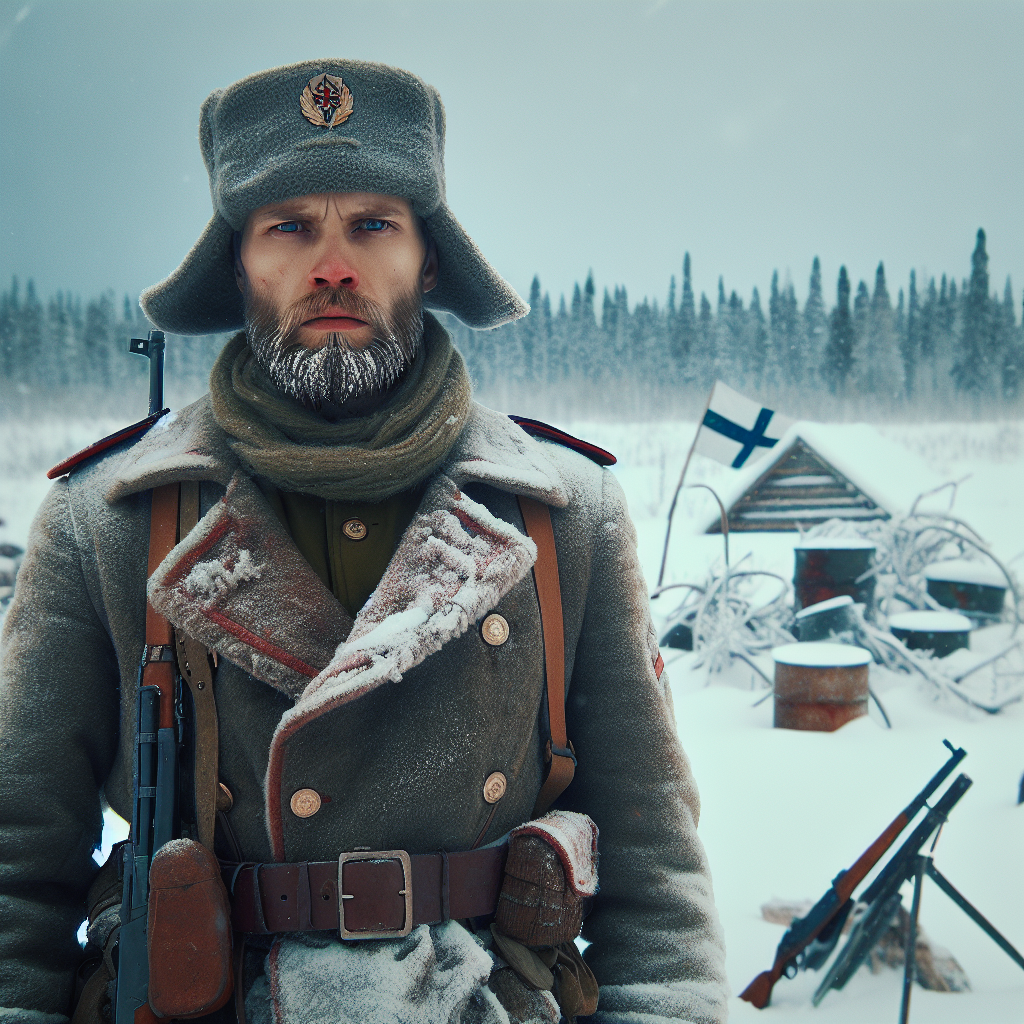
In the waning decades of the 16th century, the territories of Finland and Karelia thrummed with tension and conflict, as the Swedish and Russian Empires vied for supremacy. Bands of local Finns and Karelians, emboldened by their desperation, would routinely launch audacious raids deep into the heart of these sprawling empires. One fateful summer in 1589, amid the smoke rising from the besieged town of Kandalaksha, a ragged column of determined Finns made their way toward their next target: the city of Kem. Leading the charge was none other than Pekka Vesainen, a name that would resonate through history as a legendary figure of resistance.
Source: Personal Collection
The Long Wrath – A 25-Year Odyssey
Throughout this tumultuous period, the Kingdom of Sweden and the Tsardom of Russia found themselves embroiled in a series of skirmishes over territories that encompass modern-day Finland, Estonia, Latvia, and parts of Russia. The Treaty of Nöteborg, established in 1326, initially delineated the borders between these two rivals. Yet, as both empires expanded and populations swelled, the treaty rapidly became obsolete. Encouraged by Swedish authorities, settlements in Ostrobothnia and Savonia began to push northeast, igniting frequent clashes with the Karelians in the region.
When King John III ascended to the Swedish throne in 1569, he initiated a 25-year conflict aimed at securing control over Livonia and Karelia. While battles in the south adhered to conventional warfare, the northern theaters devolved into brutal guerrilla tactics. Russia, stretched thin under the combined pressures of a Swedish and Polish-Lithuanian alliance, was forced to negotiate a truce in 1583. Yet, tribal skirmishes continued to plague the northern woodlands. Supported by Russian forces, Karelians raided Kainuu and North Ostrobothnia, while the settlers retaliated with incursions into Karelia.
For a quarter of a century, both sides indulged in relentless pillaging and destruction, leaving the landscape desolate. Eventually, Sweden committed more resources to the Finnish struggle, culminating in the signing of the Treaty of Teusina in 1595. Though peace returned to the region, echoes of unrest would linger for generations.
Who Was Pekka Vesainen?
Historical records about Pekka Vesainen remain scant, a reflection of the tumultuous times in which he lived. His existence is corroborated by Swedish documents from 1563, where he is referred to as Petr Vesa. The specifics of his birthplace, however, remain contested; some argue Utajärvi, while a prevalent theory posits that he hailed from Vesala, then a part of Ii. The details of his family life are similarly murky, though legends suggest he was married and had seven children. Tax records from 1571 indicate he owned a modest collection of livestock—one horse, four cows, four bulls, and four sheep—pointing to a life typical for his community. His role as an Assistant Lay Judge in the Municipality of Ii suggests a man of respect and responsibility.
Vesainen is believed to have passed away in 1627, in the same home where he spent his life. However, some legends recount a more dramatic ending, where he fell victim to a Karelian captive during a retreat from Kola.
Vesainen’s Expedition
As Swedish and Russian armies lay low following the Truce of Plussa, tribal skirmishes in the northern forests flared up. Throughout the 1580s, Russian forces, primarily composed of Karelians, unleashed devastation upon Kainuu and North Ostrobothnia. The Swedish Crown, preoccupied with southern conflicts, neglected its northern settlements. In the aftermath of one such raid, a prosperous peasant named Pekka Vesainen emerged as a leader of an armed militia. Esteemed in his community, he rallied between 90 to 100 men (some Russian accounts boast numbers as high as 900) and directed them toward the White Sea, launching attacks on several Russian and Karelian settlements along the way.
On the Feast of St. Peter, they descended upon Kandalaksha in the early hours of the morning, catching the revelers off-guard as they celebrated. The raid was brutal; the town burned, and countless lives were lost. The raiders then turned southward, plundering the small fishing village of Kem before deciding to return home. However, laden with spoils, they faced difficulties on the journey back. In retaliation, Russian forces swept deep into Ostrobothnia, razing villages in their path. Upon return, Vesainen discovered the devastating news: his wife had been taken captive and two of his children had perished. Consumed by grief, he gathered another band of men and set out once more, this time targeting the Arctic coast. On Christmas Eve 1589, they stormed the Petsamo Monastery, mercilessly slaying over 100 monks and worshipers before incinerating the sacred site. They then advanced to Kola, but when they faced fortified Russian defenses led by a Voivode, Vesainen found himself forced into retreat. He returned home in early 1590, having rescued his wife (though details remain foggy), only to find a quiet life once more.
Source: Personal Collection
Later in 1590, tales suggest that King Johan III personally visited Vesainen, bestowing gifts in recognition of his efforts. Yet, the tranquility was short-lived; another Russian raid devastated the Ii and Kiiminki areas, claiming three more of Vesainen’s children and breaking his spirit.
The Legend Grows
Given the passage of time and the nature of his region, documented evidence of Pekka Vesainen’s life is limited. Aside from a handful of tax records, much of what we know derives from oral tradition. While such narratives can provide cultural context, they are also susceptible to embellishment, shaped by the prevailing societal trends of the time. Therefore, it is essential to approach these stories with a balanced perspective, integrating verifiable information with traditional accounts.
The lore surrounding Pekka Vesainen, influenced by oral traditions, began to burgeon. A tax record from 1589, wherein the Ostrobothnia bailiff collected shares of Vesainen’s spoils, confirms his involvement in the assaults at Kandalaksha and Kem. The expedition to Kola is less certain; many historians contend that he may not have participated due to the lack of supporting evidence. Regardless, the mythos surrounding him has flourished.
The rise of Finnish nationalism in the 18th century witnessed a resurgence of interest in national heroes, romanticized in literature as archetypes of bravery against foreign invaders. Vesainen’s narrative gained significant traction in 1894 with Santeri Ivalo’s publication of ‘Juho Vesainen,’ further cementing his status as a symbol of Ostrobothnian valor. In 1936, a grand statue was erected in Vesala, and in 1940, a life-sized statue was unveiled at Ii’s Parish Church, solidifying his legacy in the annals of Finnish history.
Sources
Muhos. (n.d.). https://www.tiedonportailla.fi/muhoksenhistoriaa/pitkaviha.htm
The legend of Pekka Vesainen is true and false. (n.d.). http://kirjastolinkit.ouka.fi/kaleva/elo12/pekkavesaisen.htm
Biography Sampo. (n.d.). Biography Sampo. https://biografiasampo.fi/henkilo/p5888
Enbuske, Matti: The history of Pekka Vesainen: mythical guerilla leader, tough peasant from the 16th century. Faravid, 2013, 37th vsk, pp. 35–57. Oulu: Historical Society of Northern Finland. ISSN 0356-5629
Muraina, MB (2015). Oral Tradition as a Reliable Source of Historical Writing: Arguments for and Against and Implications for Historical Writing in Education. Historical Research Letter, 22, 17–20. https://www.iiste.org/Journals/index.php/HRL/article/download/23884/24455